At a time when the global economy is facing uncertainty, unemployment is rising, inflation continues to burden ordinary citizens, and millions of young people are struggling for opportunities, India requires a strong and united opposition more than ever before. Repeated examination paper leaks, shrinking employment opportunities, growing economic disparities, and concerns over democratic institutions have created widespread public dissatisfaction. Yet, the opposition appears increasingly fragmented and unable to effectively channel these concerns into a coordinated political movement.
The recent developments within the opposition camp have further weakened the prospects of presenting a united challenge to the BJP. The crisis within the Trinamool Congress (TMC) in West Bengal has raised questions about the future strength of one of the largest opposition parties in the country. At the same time, the fallout between the Congress and the DMK in Tamil Nadu has dealt a major blow to the INDIA alliance, which was formed with the objective of providing a collective national alternative to the BJP. Reports of the DMK distancing itself from INDIA bloc activities and boycotting alliance meetings have intensified concerns about the future of opposition unity. The alliance that once promised a broad-based democratic front now appears increasingly fragile.
The BJP continues to benefit from a centralized leadership structure, disciplined cadre network, vast organizational resources, and a coherent electoral strategy. In contrast, opposition parties remain divided by regional ambitions, leadership rivalries, and tactical disagreements. While many opposition leaders acknowledge the need for unity, concrete efforts toward building a common political platform remain limited.
The greatest victims of this political disunity are the youth, farmers, workers, students, and marginalized communities who expect opposition parties to collectively raise issues such as unemployment, social justice, educational reforms, economic distress, and constitutional values. The public is not merely looking for criticism of the government; it is seeking a credible and united alternative capable of governing the country and addressing pressing national challenges.
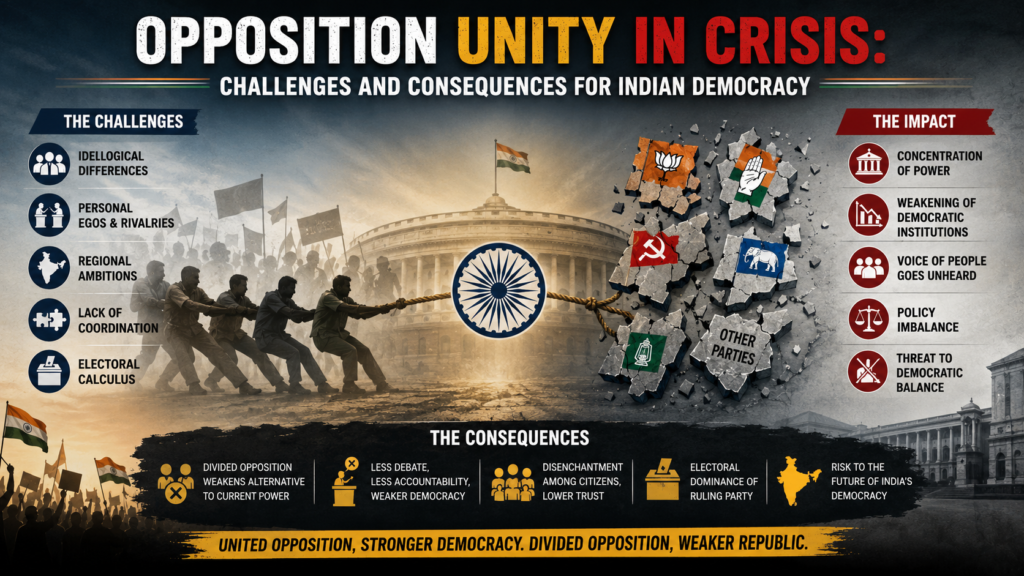
India’s political history demonstrates that transformative electoral battles have often been won when diverse opposition forces came together around common democratic objectives. The defeat of dominant political forces in various periods of Indian history was possible only because opposition parties prioritized collective goals over individual ambitions.
If the opposition continues to remain fragmented, the BJP’s political dominance is likely to strengthen further. The need of the hour is not personality-driven politics or regional calculations, but issue-based unity centered on employment generation, economic recovery, social justice, federalism, educational reforms, and the protection of democratic institutions.
In the midst of economic uncertainty, rising unemployment, recurring paper leaks, and growing public frustration, opposition unity is no longer merely a political necessity, it is a democratic imperative.
Gowd Kiran Kumar
Center Head, CPPS